


A marketing director at a health system opens ChatGPT and types: “Which agencies build accessible, HIPAA-ready websites for hospitals in the Northeast?” Ten seconds later, AI search has handed her four names and a short reason for each. She did not see ten blue links. There was no page two. If your agency was not one of the four, you were never in the running.
That is the shift. Search used to hand buyers a list of pages to read. AI search hands them a shortlist. This post explains how that shortlist gets made and what an agency, or any professional services firm, can do to be on it.
The shortlist is being written before anyone visits your site
In a G2 survey of more than 1,000 B2B software buyers, about half said they now start their buying journey in an AI chatbot instead of Google, and AI chat ranked as the top source for building a shortlist, ahead of review sites and vendor websites. That research is about software, not agencies, but the behavior carries over. The people who hire agencies are the same people who have learned to ask an assistant first.
The practical consequence: by the time a prospect lands on your homepage, an AI has often already told them who you are, what you are good at and who else to consider. Your website is no longer the first impression. It is the second.
How an AI search answer gets made
There are two ingredients in most AI answers.
What the model already learned. Large language models are trained on a huge sample of the public web. If your agency has been described consistently, in many places, over several years, the model has a picture of you before anyone asks.
What it looks up right now. For questions like “best agency for X,” most assistants also run live searches, read a handful of pages and write a summary. The pages they pull tend to be rankings, directories, reviews, news coverage and pages that answer the question directly.
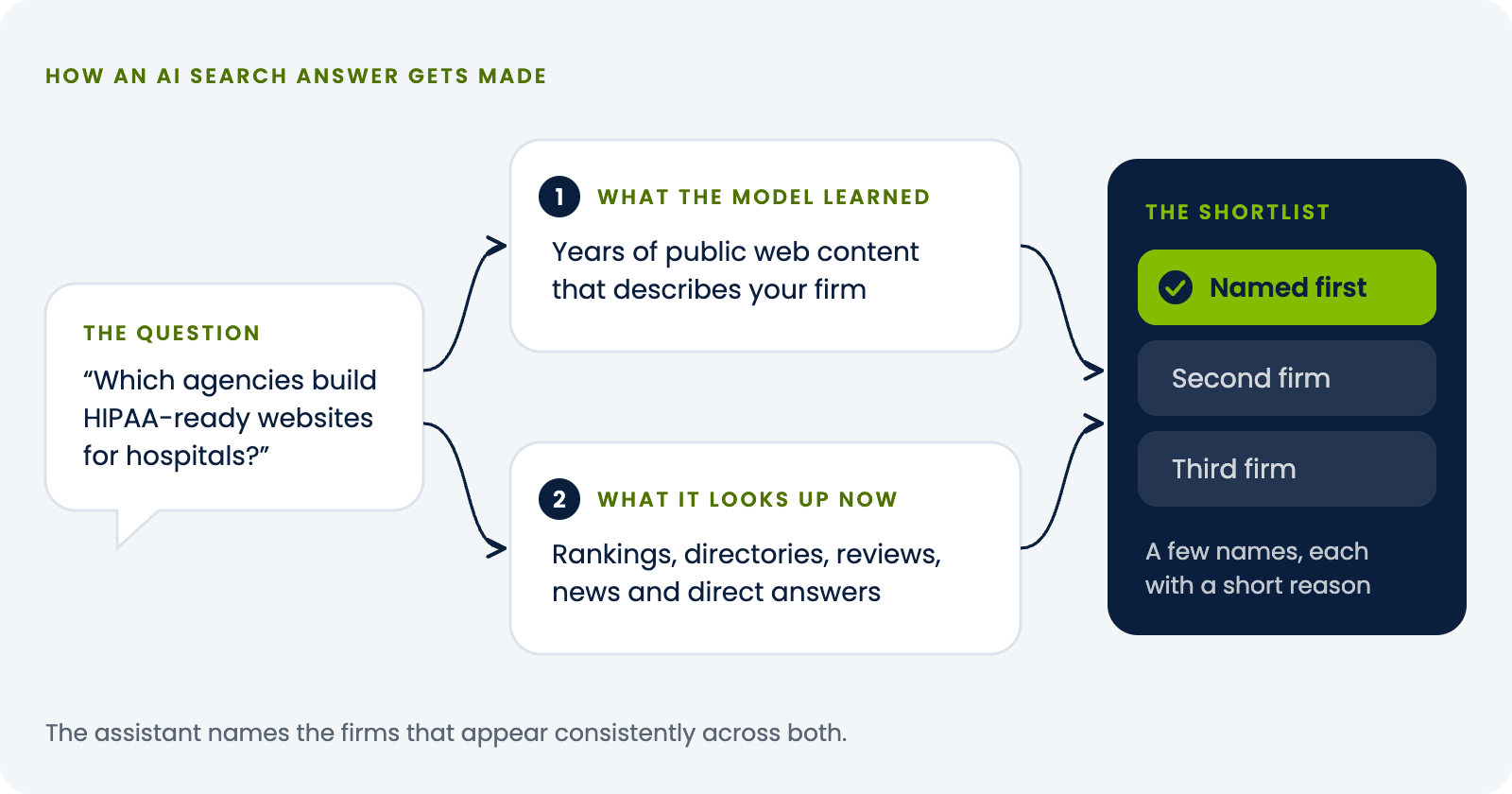
The assistant then does something a search engine never did. It forms a view. It names the firms that show up repeatedly across the sources it trusts, and it explains why in a sentence or two. Those sentences are built from whatever the web says about you.
Different engines, different sources, the same names
BrightEdge compared five AI engines (ChatGPT, Perplexity, Gemini, Google AI Mode and Google AI Overviews) in April 2026. The sources they cited overlapped by as little as 16 percent between some pairs of engines. The brands they named overlapped far more consistently, between 36 and 55 percent.
Read that twice, because it changes the strategy. AI search engines disagree about where to look, and they still land on many of the same companies. You cannot win by gaming one engine or one source. You win by having a reputation that reads the same wherever a machine happens to look.
Most of what AI search reads about you is not on your website
When an assistant recommends a company, the evidence it cites is usually someone else’s page. One analysis of product recommendations, reported by Search Engine Journal, found that fewer than 3 percent of the sources cited by ChatGPT, Perplexity and Google AI Mode were pages owned by the brand being recommended. That study looked at consumer products, so treat the number as a signal, not a benchmark for services.
For an agency, the equivalent third-party sources are easy to list: directories such as Clutch and DesignRush, platform partner listings, awards, client press releases, conference talks, podcasts, bylined articles and LinkedIn. If those say something different from your website, or say nothing, the assistant has little to work with.
Five things that make a firm the answer
1. Say exactly what you do, for whom, in the same words everywhere
“Full-service digital agency” matches no question a buyer asks. “Websites and digital marketing for healthcare, financial services and life sciences companies” matches several. Pick the sentence, then use it on your homepage, your directory profiles, your LinkedIn page and your partner listings. Consistency is what lets a model connect the mentions into one picture.
2. Publish proof a machine can read
For AI search, case studies are the strongest evidence you own. Write them as text, not as images or PDFs. Name the client, the industry, the problem, what you built and the result. A sentence like “we rebuilt a community health center’s website on WordPress and launched a separate urgent care site” gives an assistant something specific to repeat. “We delivered a transformative digital experience” gives it nothing.
3. Answer the questions buyers really ask
List the questions prospects put to you on sales calls: how long does a redesign take, what does it cost, can you make an existing site accessible without rebuilding it, how do you handle legal review. Give each one a page or a clearly labeled section, and answer in the first sentence. Assistants favor pages that state the answer plainly and then support it.
4. Make the site easy for machines to read
This is the technical layer of AI search, and it is where many good firms lose ground.
- Serve real text in the page source. Content that only appears after scripts run is often missed.
- Use one clear H1 and descriptive headings.
- Add structured data for your organization, services, articles and FAQs.
- Check that your robots.txt is not blocking the crawlers AI companies use.
- Keep pages fast and accessible. The same clean structure that helps a screen reader helps a model.
Some sites also publish an llms.txt file to point AI systems at their most important content. It is cheap to add, but its effect is unproven, so do not treat it as a strategy.
5. Earn mentions where the engines look
Keep your directory profiles complete and current. Ask clients for reviews on the platforms that matter in your category. Get listed by your technology partners. Publish under your own name in places your buyers read. Each credible mention is one more source that agrees with the others.
What does not work in AI search
Keyword stuffing, hundreds of thin AI-written pages and paid placements on low-quality “best of” lists may move a number for a few weeks. They do not build the thing AI search rewards, which is a consistent reputation across independent sources. They also do not survive a prospect asking the assistant a follow-up question.
How to check where you stand in AI search
You do not need a tool to start. Write down ten questions your ideal client would ask, including your city, your industries and the specific problem you solve. Ask each one in ChatGPT, Perplexity, Gemini and Google. Record three things: who gets named, what is said about them and which sources are cited.
Do it again next month. Answers vary from one run to the next, so one test proves little. The pattern over time tells you which competitors AI search favors, which sources they lean on in your category and where your own story is missing or out of date.
The takeaway
AI search has not replaced reputation. It has automated the process of checking it. The firms that get recommended are the ones that are specific about what they do, have published evidence that they do it well and are described the same way by other people.
That is good news for firms that do serious work. The job now is to make sure the proof is written down where a machine can find it.
Consensus Interactive builds websites and content programs designed to be found, read and recommended by AI search. If you want to know how the engines describe your company today, tell us what is in the way.